Lineage
Lineage
About
| Full Name | Oswaldo Gomes da Rosa |
| Nickname | “Paquetá” |
| Date of Birth | 1940 |
| Date of Passing | August 3, 2012 |
| Rank & Title | 9th-Degree Grand Master Red Belt (Faixa Vermelha) |
| Promoted By | Carlson Gracie (Black Belt) / Robson Gracie (Red Belt) |
| Signature Specialty | Tremendous Physical Strength & Old-School Vale Tudo Positioning |
| Primary Contribution | Youth Pedagogy & Curating the World’s Largest Historical Video Archive |
| Lineage | Mitsuyo Maeda ➔ Carlos Gracie ➔ Carlson Gracie ➔ Oswaldo “Paquetá” Rosa |
Historical Achievements & Technical Milestones
- 9th-Degree Grand Master Status — Elevated to the absolute highest tier recognized in Brazilian Jiu-Jitsu, officially corrected on paper by Federation President Robson Gracie.
- The Custodian of Combat History — Built and curated a private library of over 4,500 fight tapes, widely recognized as the largest and most valuable private martial arts video archive in existence.
- Gracie Academy Staple — Forged his early competitive skill set directly alongside his lifelong best friend, Grand Master Carlson Gracie, during the foundational golden era of the sport.
- Social Youth Pioneer — Served as the executive director of FUNABEN, utilizing both traditional Judo and Jiu-Jitsu to rehabilitate and educate underrepresented children and adolescents.
Overview
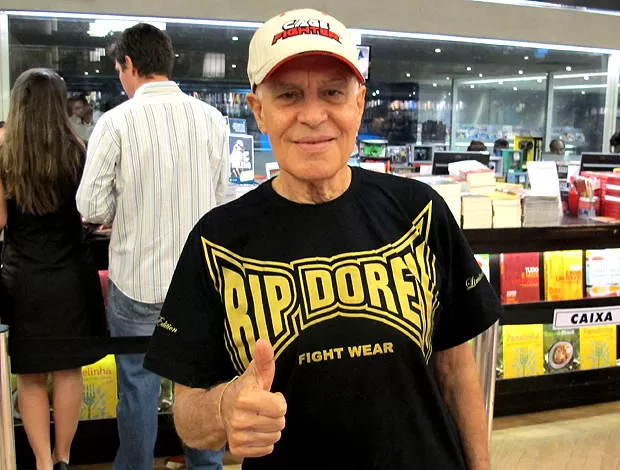
Grand Master Oswaldo Gomes da Rosa, immortally celebrated within martial arts history simply as “Paquetá,” was a legendary 9th-degree Brazilian Jiu-Jitsu Red Belt. A foundational pioneer of the sport and a fearsome, famously strong competitor out of the historic Gracie Academy, Paquetá is best remembered as the lifelong closest friend, training partner, and confidant of the iconic Carlson Gracie. Beyond his physical prowess on the mats, his visionary efforts to preserve early combat footage transformed him into the sport’s most respected historian, leaving behind an irreplaceable technical and cultural archive.
Humble Beginnings and the Gracie Connection
Oswaldo Gomes da Rosa was born in 1940 in Rio de Janeiro, Brazil. Raised in an impoverished household by a father who worked tirelessly as a municipal street sweeper, Paquetá took up manual labor at a very young age to help financially sustain his family. Despite these severe socio-economic hardships, he developed an elite physical frame, excelling in bodybuilding and training in traditional Judo under the guidance of a Japanese master instructor named Nagashima.
In 1958, a fateful employment opportunity permanently altered his life when Paquetá landed a job as an office messenger boy in the exact commercial building that housed the world-famous Gracie Academy in Centro, Rio. Financially unable to afford the academy’s standard tuition rates, he spent his sparse lunch breaks silently observing the training floor through the doors. He quickly struck up a deep, authentic friendship with Carlson Gracie, who eventually used his considerable influence to convince his uncle, Grand Master Helio Gracie, to grant Paquetá full training access for a tiny fraction of the normal academy fee.
Immersed in daily sparring, Paquetá became legendary across the state for his terrifying raw physical strength and grip endurance. According to historical academy accounts, the only human on the mats capable of overpowering him was Carlson Gracie himself—who would famously tear thick city Yellow Pages phone books completely in half to demonstrate his crushing hand leverage to onlookers.
Pedagogy and a Handed-Down Black Belt
Deeply molded by his own difficult youth, Paquetá prioritized formal academics over competitive prestige, successfully graduating from the university as a certified pedagogue. He briefly paused his daily training output after marriage to secure his corporate footing, eventually rising to become the regional director of FUNABEN (a state foundation dedicated to protecting vulnerable children and adolescents). There, he spent many years utilizing the discipline of Jiu-Jitsu and Judo as therapeutic social tools.
Paquetá possessed an old-school mindset and cared absolutely nothing for sport politics or administrative red tape. When the original jiu-jitsu federation was established in Rio de Janeiro in the late 1960s to introduce the modern belt ranking and uniform structures, he never bothered to submit an application for an official certificate. In 1973, realizing he required formal credentials to continue his expansive youth coaching programs, he casually asked Carlson Gracie what the formal black belt examination required. Carlson completely bypassed any testing rules, immediately handing his longtime friend his own black belt on the spot in honor of Paquetá’s years of elite, undocumented competitive service against the region’s best.
The World’s Largest Fight Archive & Red Belt Elevation
In 1991, Carlson Gracie requested that Paquetá bring an early video camera to the “Atlântico Sul” tournament to capture his students’ matches for strategic technical review. This singular assignment ignited a lifelong obsession. Paquetá began traveling extensively to film every single major grappling, Vale Tudo, and mixed martial arts event he could physically access. Over the ensuing decades, this personal hobby expanded into a massive historical enterprise, culminating in a pristine private collection of over 4,500 master tapes—universally recognized as the most complete private martial arts video library on earth.
Because Paquetá did not officially register his historical paperwork with the regulatory Federation until 1993, a highly bizarre administrative oversight manifested decades later: one of Paquetá’s own direct black belt students had climbed the administrative ladder to receive a 7th-degree coral belt on paper, while Grand Master Paquetá was still technically recorded as a basic black belt in the state computer system. To immediately fix this massive hierarchical error, Federation President Robson Gracie personally visited Paquetá to formally correct his status, elevating him straight to his well-deserved 9th-degree Grand Master Red Belt.
Master Paquetá passed away on August 3, 2012, at the age of 72. He remains profoundly revered across the international combat community as the absolute mind, memory, and visual historian of original Brazilian Jiu-Jitsu.
Videos
No videos yet.