
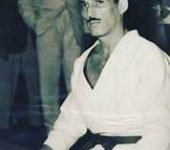
Carlos Gracie
Black Belt 10° Degree
Gracie Academy — Rio de Janeiro, Brazil
September 14, 1902 – October 7, 1994
Lineage
Lineage
About
| Full Name | Carlos Gracie Sr. |
| Nickname / Title | The Patriarch of Gracie Jiu-Jitsu |
| Rank | 10th Degree Red Belt (Posthumous Grandmaster) |
| Affiliation & Hub | Gracie Academy — Rio de Janeiro, Brazil |
Overview
Carlos Gracie (1902–1994) was a prominent Brazilian martial artist and a visionary promoter who served as the fundamental architect of Brazilian Jiu-Jitsu (BJJ). While many practitioners contributed techniques, Carlos laid the essential structural, commercial, and promotional foundation that permanently shifted the martial arts landscape, transitioning imported Japanese judo into a uniquely Brazilian combat sport.
Early Life and Training
The Spark: Born in Belém, Carlos was exposed to combat sports during his youth after witnessing the public grappling demonstrations of Japanese judoka Mitsuyo Maeda, setting off a lifelong fascination with submission fighting.
First Steps & Realities: While traditional oral lore emphasizes a long, direct apprenticeship under Maeda, historical records indicate Carlos’s exposure to Maeda was brief. His formal martial arts foundation grew dynamically years later in Rio de Janeiro, where he immersed himself in the academy spaces run by Donato Pires dos Reis and Jacintho Ferro—the actual technical crucible where Carlos forged his early skills. Demonstrating the sharp, aggressive business acumen that would define his legacy, Carlos executed a shrewd institutional takeover of Pires’s academy in 1931, rebranding the platform and launching the family empire that would change combat sports forever.
The Foundation of a New Sport
Ring Experience: Carlos had a brief, highly turbulent professional fighting career. He engaged in early exhibition matches with regional pioneers like Geo Omori, and competed in a highly contentious, politically charged 1931 professional bout against Manoel Rufino dos Santos. Recognizing that his primary talents lay in building the promotional infrastructure of the sport rather than active ring competition, Carlos retired from fighting early to focus on executive management.
The Catalyst for Change: Carlos’s true genius was serving as the ultimate coordinator and mastermind of the movement. He masterfully utilized local newspapers, public relations, and high-profile challenge matches to build a massive competitive ecosystem in Rio de Janeiro. By orchestrating the athletic careers of his brothers—most notably George and Hélio—and later his sons, Carlos established the combative framework that forced the art to evolve, ensuring his family’s operational blueprint dictated the future of global Jiu-Jitsu.
Legacy and Impact
The Gracie Diet: Heavily invested in alternative medicine and wellness, Carlos spent decades developing a strict nutritional regimen focused on strategic food combinations and maintaining a neutral blood pH. He marketed this system as an athletic secret weapon, advocating an austere lifestyle completely free of alcohol, tobacco, and processed sugars.
A Massive Dynasty: Carlos fathered 21 children, creating a formidable martial arts dynasty. By the time of his passing at age 92, his foundational promotional framework and strategic outreach had successfully transformed a regional Brazilian prize-fighting subculture into a dominant, highly organized global phenomenon.
Black Belts Promoted 17







Videos
No videos yet.