Lineage
Lineage
About
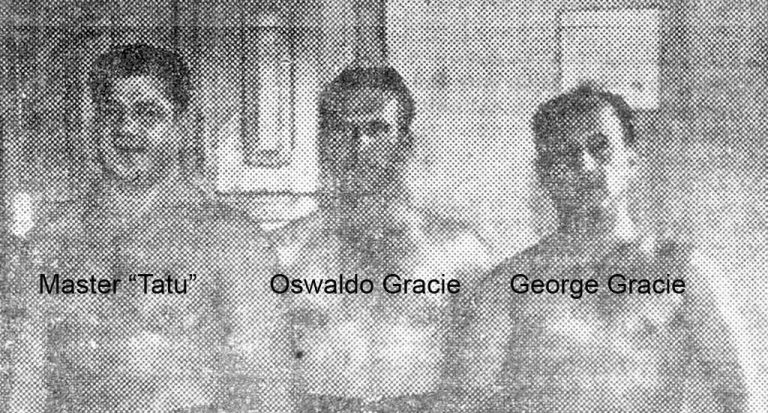
Oswaldo Gracie (1904–1943) was a foundational figure in martial arts history and a co-founder of the original Gracie Jiu-Jitsu Academy. As the second son of Gastão Gracie, he played a critical role in establishing, defending, and expanding his family’s grappling lineage during the early 20th century.
Early Life and Training
Oswaldo began his martial arts journey in 1917 when his older brother, Carlos Gracie, introduced him to Jiu-Jitsu. Carlos had been studying under Mitsuyo Maeda and his student Jacinto Ferro, using Oswaldo and their brother Gastão Jr. as training partners.
Though a financial crisis in 1921 forced Oswaldo to temporarily pause his training to work with his father, he returned to the mats full-time in 1925 to help Carlos open the historic first Gracie Academy in Rio de Janeiro.
Career and Legendary Fights
During the 1920s and 1930s, keeping a full-time martial arts academy afloat was a severe financial challenge. To keep the doors open, Oswaldo frequently took part-time jobs, engaged in public prize fights against local pier fishermen, and even competed in masked professional wrestling matches to protect his anonymity.
As an official Vale Tudo (no-holds-barred) competitor, Oswaldo became famous for defeating much larger opponents despite weighing only 62 kg (136 lbs):
The Capoeira Superfight (1931): In his official public debut, he defeated Manuel Tito Ferreira using a triangle choke.
The Baldi Match (1931): In a legendary David-vs-Goliath matchup, Oswaldo choked out João Baldi—a massive 135 kg (297 lbs) professional wrestler—in just 58 seconds.
His competitive career concluded in 1936 with a hard-fought draw against Simon Munich.
Regional Expansion and Later Years
In 1934, Oswaldo married a nurse named Ana Nery and relocated to Belo Horizonte, the capital of Minas Gerais. This move marked a massive milestone for the family business, as Oswaldo established the very first Gracie Jiu-Jitsu Academy in the state. Under his guidance, the academy became a massive hub for young fighters, trailing only Rio de Janeiro in size and influence. His work in the region is also credited by historians with influencing the development of Luta Livre Esportiva (Brazilian submission grappling).
In addition to running his academy, Oswaldo served as the official close combat instructor for the local Police Department, a position he proudly held until his untimely passing in 1943 at the age of 39.
Videos
No videos yet.