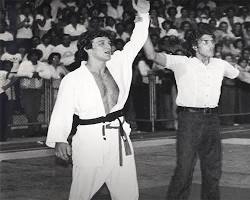
Rolls Gracie
Black Belt 6° Degree
Rolls Gracie Academy — Copacabana, Rio de Janeiro, Brazil
March 28, 1951 – June 6, 1982
Lineage
Lineage
About
| Full Legal Name | Rolls Gracie |
| Date of Birth | March 28, 1951 |
| Date of Passing | June 6, 1983 (Aged 32) |
| Rank & Title | 6th-Degree Black Belt & Grand Master Innovator |
| Weight Division | Peso Pena (Featherweight — 64 kg / 141 lbs) & Absolute Openweight |
| Raised & Influenced By | Hélio Gracie & Carlos Gracie Sr. |
| Signature Specialty | Cross-Disciplinary Integration, Aggressive Submissions & Open Guard Versatility |
| Lineage | Mitsuyo Maeda ➔ Carlos Gracie Sr. ➔ Hélio Gracie ➔ Rolls Gracie |
Key Achievements & Historical Milestones
- The Father of Modern Cross-Training — Shattered rigid isolationist dogmas by methodically integrating technical assets from Freestyle Wrestling, Sambo, and Judo into traditional Gracie frameworks.
- Pan American Sambo Champion (1979) — Dominated international competition brackets to capture gold across both his natural weight class and the open-weight Absolute division.
- Pan American Wrestling Gold (1979) — Proven international freestyle wrestling vanguard, capturing continental first place under FILA parameters.
- 2x Rio de Janeiro State Absolute Champion — Captured the prestigious Campeonato de Jiu Jitsu da Guanabara Weight and Absolute crowns back-to-back (1973 / 1974) as a lightweight.
- Foundational Lineage Anchor — Hand-promoted and shaped the technical minds of the sport’s greatest master coaches, directly guiding icons like Carlos Gracie Jr. (Gracie Barra) and Romero “Jacaré” Cavalcanti (Alliance).
Overview
Grand Master Rolls Gracie is universally revered as the single most transformative, revolutionary icon in the history of modern Brazilian Jiu-Jitsu. As his brother Royler Gracie famously observed, “There is an era before and another one after Rolls.” The undisputed champion of the Gracie clan throughout the golden era of the 1970s, Rolls re-engineered a localized self-defense framework into a highly dynamic, evolving international martial science. Operating as the premier pioneer of cross-disciplinary training, his profound open-mindedness to alternative grappling arts permanently altered the movement mechanics, strategy, and physical culture of contemporary sport jiu-jitsu.
Early Life & The Cross-Training Genesis
Rolls Gracie was born on March 28, 1951, in Rio de Janeiro, Brazil. He was the biological son of Gracie Jiu-Jitsu co-founder Grand Master Carlos Gracie Sr., but was primarily raised, insulated, and educated under the strict, loving care of his uncle, Grand Master Hélio Gracie. Growing up on the hyper-competitive mats of the original Academia Gracie, Rolls developed a sleek, lightweight physical build. Competing routinely within the Peso Pena (Featherweight / 64 kg) limits, he weaponized flawless kinetic mechanics and unparalleled structural pressure to comfortably out-maneuver and submit global heavyweights.
During an era when the founding family guarded their combat philosophies behind traditionalist walls, Rolls executed a radical break from convention. Recognizing that no single art held an absolute monopoly on tactical truth, he became the first Gracie to actively seek answers inside outside grappling arenas. He traveled globally to submerge his lifestyle within alternative arts, cross-training heavily in Freestyle and Greco-Roman Wrestling under five-time US Champion Bob Anderson, refining his throwing arcs in Judo alongside legendary master Osvaldo Alves, and cleaning out continental Sambo brackets to secure multi-time Pan American gold medals. To cultivate an unprecedented level of dynamic core stability and movement efficiency, he also integrated Olympic gymnastics into his weekly regimes. He famously became the very first member of the Gracie family to buy a surfboard, permanently introducing the deep-rooted cultural synthesis between BJJ and Rio’s ocean lifestyle.
Mythical Mat Feats & Heavyweight Destructions
Rolls’ technical clarity on the mats achieved a near-mystical status throughout South America. A famous historical account details an encounter with elite US Heavyweight wrestler Bob Anderson, who initially questioned how a slender featherweight like Rolls could realistically hold open-weight titles. Accepting a casual, closed-door sparring invitation, Anderson was completely neutralized, with Rolls clinical-ly applying a sequence of chokes and locks to submit the massive heavyweight 10 consecutive times in a matter of minutes, leaving the American wrestler in complete awe of the leverage.
His real-world self-defense capacity was equally undeniable. Following a confrontational beach scuffle involving one of his teenage pupils, Rolls and a small contingency of practitioners arrived at Arpoador beach to directly confront a notorious group of local street bullies. The ensuing technical clinic was so clean and effortlessly handled that dozens of watching beachgoers and surfers walked into his academy weeks later to initiate their own martial arts journeys.
Tragic Passing & Architectural Legacy
Clashing at times with the rigid traditionalism of old-school paradigms, Rolls eventually partnered alongside his older brother, Carlson Gracie, before setting up his own independent training hall in Copacabana, where he was strategically assisted by his younger brother, Carlos Gracie Jr.
Tragically, Rolls’ visionary path was abruptly cut short on June 6, 1983, at the young age of 32, due to a fatal paragliding accident. He left behind his beloved wife and two infant sons, Rolles and Igor Gracie, sending a wave of profound shock and grief across the entire international martial arts community. Despite his brief time on earth, his systemic methodology revolutionized the craft. By serving as the principal mentor and graduation authority for icons like Rickson Gracie, Royce Gracie, Carlos Gracie Jr. (Founder of Gracie Barra), and Romero “Jacaré” Cavalcanti (Founder of Alliance BJJ), Grand Master Rolls Gracie remains immortally enshrined as the eternal architect of technical evolution, physical fearlessness, and martial arts truth.
Black Belts Promoted 6


Videos
No videos yet.