Lineage
Lineage
About
| Full Name | Reylson Gracie |
| Date of Birth | August 12, 1943 |
| Rank & Title | 9th Degree Red Belt (Grand Master) |
| Signature Innovations | Named “Mata Leão” & “Americana”, Introduced Colored Gis |
| Affiliation & Focus | Gracie Jiu-Jitsu (Pure Self-Defense Curriculum) |
Overview
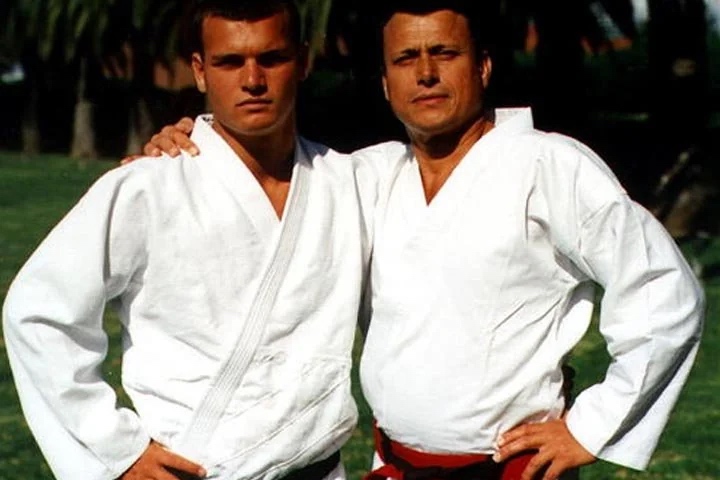
Reylson Gracie (born August 12, 1943, in Rio de Janeiro, Brazil) is a 9th-degree Red Belt (Grand Master) in Brazilian Jiu-Jitsu. As a son of BJJ founder Carlos Gracie Sr., Reylson is celebrated as a foundational pioneer of the art’s self-defense system, a key architect of modern BJJ terminology, and a true visionary who revolutionized martial arts fashion.
Early Life and Training
Born into grappling royalty, Reylson began his Jiu-Jitsu training at the tender age of four. His instruction was primarily spearheaded by his uncle, Helio Gracie. Reylson showed a natural aptitude for the family trade early on; by age 14, he was already assisting with classes, teaching the core Gracie self-defense curriculum.
In 1962, at just 18 years old, Reylson was awarded his black belt (“professor” status), making him one of the youngest in the family’s history to achieve the rank at the time. A year later, in 1963, he became the first of Carlos Gracie’s sons to break away and open an independent gym.
Naming the “Mata Leão” and “Americana”
Beyond his physical prowess, Reylson heavily influenced the vocabulary of modern ground fighting.
The Mata Leão: Prior to 1963, the classic rear-naked choke was formally known in Brazil as the estrangulamento técnico (technical strangle-hold). Reylson changed this after seeing photographs of Kyokushin Karate founder Mas Oyama, who was famously dubbed a “lion” of a man. Reylson remarked that despite Oyama’s strength, he could secure a choke from the back, calling it the ultimate “lion killer” (mata leão). The descriptive name was instantly adopted by the Gracie family and remains the universal term across Portuguese-speaking grappling communities today.
The Americana: Reylson is also credited with coining the term “Americana” to describe the bent armlock, creating a distinct verbal separation between it and the straight armlock, which previously shared the same name.
Shaking Up Gi Fashion
In the late 1970s, Reylson shattered long-standing martial arts traditions by introducing the very first colored kimonos (gis) to Brazilian Jiu-Jitsu. Inspired by watching Bruce Lee’s iconic yellow jumpsuit in Game of Death, Reylson stepped away from traditional white uniforms and manufactured his first custom gis in bold black, yellow, and turquoise—pioneering an industry that would eventually become a staple of modern BJJ lifestyle culture.
The Move to America and Return to Roots
In 1975, Reylson established his most famous Brazilian academy in the upscale Shopping da Gávea, teaching the elite of Rio de Janeiro’s society. However, in 1991, facing harsh economic reforms instituted by Brazilian President Fernando Collor de Mello, Reylson chose to relocate to the United States.
He initially established an academy in Corona del Mar, California, before moving his operations to Las Vegas, and eventually settling in South Florida (Boca Raton and Delray Beach). During his tenure in the U.S., he focused heavily on spreading the traditional, non-sporting aspects of his family’s art, famously producing one of the earliest American BJJ black belts, Ken Gabrielson, in 1995.
Later Years and Legacy
In 2012, after decades abroad, Reylson returned to Rio de Janeiro. Vocal about his distaste for the point-driven, sport-centric evolution of modern tournament BJJ, he dedicated his return to preserving and restoring the pure, self-defense martial traditions taught by his father. He re-opened his historic gym at the Shopping da Gávea to ensure the original Gracie philosophy endures for future generations.
Black Belts Promoted 2


Videos
No videos yet.